
Turkey & Morocco Sourcing Guide: How Global Traders Import Dyestuffs from India
A distributor in Bursa places an order, gets a price and a smile, and no real answer on when the container actually lands. Six weeks later it's still "in transit" somewhere past Suez, the dye house is idle, and the only paperwork that showed up with the shipment is an invoice — no CoA, no REACH letter, nothing the buyer's own customer asked for.
That's the actual failure mode we see on the Turkey and Morocco corridor, and it has nothing to do with the dye itself. It's a supplier who can quote a price but can't tell you which port pair gets you a weekly sailing versus a once-a-month gamble, and can't tell you what your buyer's compliance team is going to ask for before they'll open a second PO. This guide is the one we wish existed when we started shipping into these two markets — the ports, the transit windows, and the paperwork, laid out plainly.
QUICK SUMMARY: SOURCING DYESTUFFS FROM INDIA FOR TURKEY & MOROCCO
India ships to Turkey primarily via Mundra or Nhava Sheva to Mersin or Ambarli (Istanbul), typically 18–25 days FCL via the Suez Canal route.
India ships to Morocco via the same Indian ports to Casablanca (roughly 20–25 days) or Tanger Med (roughly 22–28 days).
Transit windows shift with Suez Canal routing conditions and carrier schedules — always confirm current transit with your freight forwarder before committing to a delivery date.
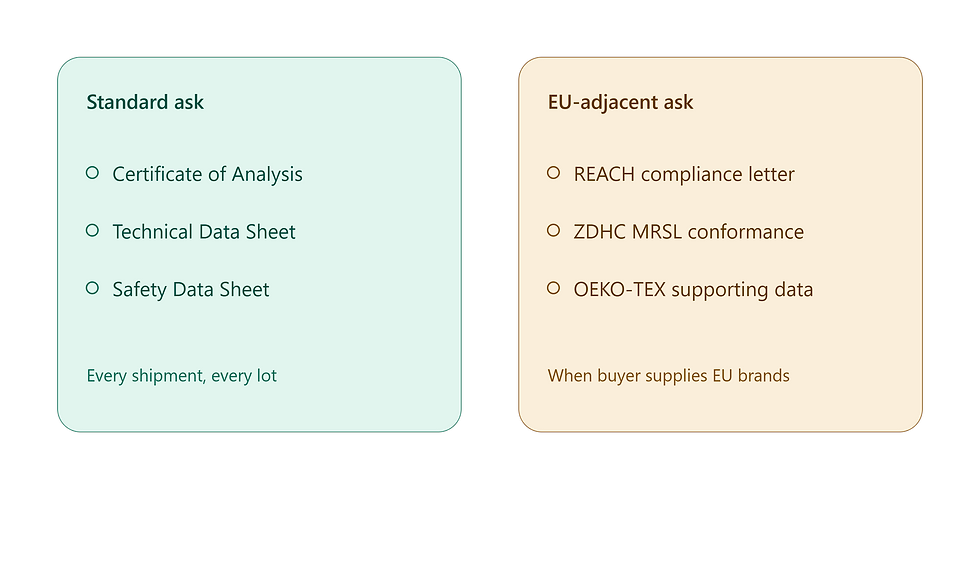
Baseline documentation for any dyestuff shipment is CoA, TDS, and MSDS/SDS. Buyers supplying EU-facing brands from Turkey or Morocco increasingly also ask for REACH compliance declarations and ZDHC MRSL conformance.
Turkey runs its own chemical registration regime, KKDIK, separate from EU REACH — worth knowing even though it's a Turkish-side importer obligation, not something the Indian exporter files. Dyestuffs are generally classified under HS Chapter 32 for customs purposes.
Reactive dyes (Colactive) suit garment-grade cotton for EU/US-bound exports; Acid dyes (Colacid) suit Turkey's large wool, leather, and nylon processing base; Direct dyes (Colrect) suit economy cotton and packaging-grade applications.

Why Turkey and Morocco Are Strategic Sourcing Corridors Right Now
Both countries sit on the direct manufacturing route into the EU, and both have textile industries built specifically to serve European brands on shorter lead times than East Asia can offer. Turkey's dye houses in Bursa, Kayseri, and Gaziantep supply denim, knitwear, and home textiles straight into German and Italian retail chains. Morocco's garment zones around Tangier and Casablanca do the same for Spanish and French buyers, often on near-shore, fast-fashion replenishment cycles.
What that means for a distributor or agent in either country: your dye supply chain has to be as reliable as your customer's production schedule. A Chinese dye delayed at customs, or a European dye priced 30–40% higher than the Indian equivalent, is a real cost either way. India offers a middle path — competitive pricing, four-decade manufacturing depth, and a shipping lane into the Mediterranean that's shorter than most people assume.
India remains the world's largest reactive dye producer, and the manufacturing base in Ahmedabad's GIDC Vatva industrial zone — where Avi Chemicals has operated since 1980 — exists specifically to serve export markets like yours. The advantage isn't just price. It's depth of range: a single Indian manufacturer can usually cover reactive, acid, and direct dye requirements in one relationship, rather than you managing three separate suppliers across three countries.
The trade-off buyers need to manage honestly is lead time. India is not next door to Turkey or Morocco the way a European supplier would be. That's exactly why the shipping section below matters — plan your reorder point around real transit windows, not assumptions.
Shipping & Logistics: Ahmedabad to Turkish and Moroccan Ports
Dyestuff cargo from Avi Chemicals moves by road from our Ahmedabad facility to either Mundra Port (Gujarat) or Nhava Sheva/JNPT (near Mumbai) — India's two primary container gateways for west-bound export. From there, it's a single ocean leg through the Arabian Sea, the Suez Canal, and the Mediterranean to your receiving port.
To Turkey: FCL shipments from Mundra or Nhava Sheva to Mersin or Ambarli (Istanbul) typically run 18–25 days, depending on the carrier's routing and number of transshipment calls. Some direct or near-direct services to ports like Derince have posted transit as short as 15 days, though these are less frequent sailings — expect a departure roughly every 2–4 weeks rather than a weekly service. Once cargo lands at a Turkish Mediterranean port, road delivery further into Europe typically adds only 3–5 days, which is part of why Turkey functions as a re-export gateway as well as a domestic dyeing hub.
To Morocco: The same Indian ports connect to Casablanca in roughly 20–25 days and to Tanger Med in roughly 22–28 days via the identical Suez Canal routing. A handful of consolidators run faster direct LCL services on this lane — occasionally quoting transit in the 16–20 day range — but these are carrier- and season-specific, so treat them as best-case, not standard planning figures.
One planning note that matters more than the exact day count: transit times on this corridor move with Suez Canal routing conditions. Regional security conditions in the Red Sea have, at times over the past two years, pushed some carriers to reroute around the Cape of Good Hope, which can add two to three weeks to a sailing. Before you commit to a delivery date with your own downstream customer, ask your forwarder to confirm the current routing status for your specific carrier and sailing — don't assume the Suez route is guaranteed on every booking.

Documentation & Compliance Checklist for Turkey and Morocco Imports
Every dyestuff shipment out of India should arrive with three baseline documents, regardless of destination:
Certificate of Analysis (CoA) — dye strength, shade match (ΔE against standard), solubility, and pH, specific to that production lot.
Technical Data Sheet (TDS) — application parameters, recommended dosage, compatibility notes.
Material Safety Data Sheet (MSDS/SDS) — hazard classification, handling, and storage guidance, required for customs clearance in virtually every jurisdiction.
Because Turkey and Morocco both manufacture heavily for EU brands, buyers in these two markets increasingly face a second, stricter tier of documentation requests from their own customers:
REACH compliance declaration — confirms the dye doesn't contain substances restricted under EU chemical regulation, relevant because Turkish and Moroccan mills are effectively part of the EU's extended supply chain.
ZDHC MRSL conformance — increasingly requested by garment brands operating a Zero Discharge of Hazardous Chemicals program, particularly for reactive dyes going into cotton apparel.
OEKO-TEX Standard 100 supporting data — not a certification the dye itself carries, but wash-fastness and residual-substance data your mill needs to support its own OEKO-TEX certification.
The practical difference: a trader supplying a domestic Turkish dye house for the local market can usually operate on the three baseline documents. A trader supplying a mill that exports finished garments to Zara, Mango, or a German retailer should expect the buyer's compliance team to ask for the second tier before the first purchase order is approved — not after.
Turkey has its own chemical registration regime, separate from EU REACH. Since 2017, Turkey has run KKDIK (Kimyasalların Kaydı, Değerlendirilmesi, İzni ve Kısıtlanması) — a regulation modeled closely on REACH but administered independently by Turkey's Ministry of Environment, Urbanization and Climate Change. Any Turkish entity importing a chemical substance at or above one tonne per year is expected to hold a registration under KKDIK, generally through a locally appointed Only Representative or the importer of record. This is a Turkish-side compliance obligation, not something an Indian exporter files — but a buyer who understands the difference between "we hold REACH data" and "we're KKDIK-registered in Turkey" reads as someone who's actually shipped into this market before, not someone reciting a generic compliance checklist. Confirm the current KKDIK registration status of the substances you're importing with your customs or regulatory contact in Turkey.
Customs classification: dyestuffs are generally classified under HS Chapter 32 (tanning/dyeing extracts, colouring matter), with the specific six-digit heading depending on dye class — reactive, acid, and direct dyes each fall under slightly different subheadings. Duty rates and any preferential tariff treatment vary by trade agreement status and change periodically, so confirm the current applicable rate with a licensed customs broker in Turkey or Morocco rather than relying on a rate quoted in any
article, including this one.
What to Ask an Indian Dye Supplier Before You Place an Order
Before committing to a new supplier for the Turkey or Morocco corridor, get straight answers on these:
Manufacturer or trader? A manufacturer controls lot-to-lot consistency directly. A trader is reselling someone else's production and can't always guarantee it.
What's the lot-to-lot strength tolerance? Industry standard is ±2–3%. Wider than that shows up as visible shade drift in your customer's bulk dyeing.
Can they issue a REACH declaration or ZDHC conformance letter on request? If your buyer supplies EU brands, this should be a yes without hesitation.
What's the real MOQ, and does it work with a shared container? Mixing reactive, acid, and direct dye orders into one consolidated shipment is standard practice and worth discussing before your first order — see our dyestuff MOQ and container cost guide for the full cost breakdown.
What's the current transit estimate for your specific port pair? Ask them to confirm with their forwarder rather than quoting from memory — Suez routing conditions change.
Which Dye Class Fits Which Buyer
Turkey's textile base spans denim, knitwear, and a substantial wool and leather processing sector — which means demand splits across all three major dye classes. Morocco's garment zones around Tangier and Casablanca lean heavily toward cotton knitwear and woven apparel for European fast fashion, but Morocco also carries a real leather industry of its own — the tanneries of Fez have processed hides for centuries, and that base still generates steady acid dye demand alongside the cotton-focused reactive dye volume from the garment zones. Treat Morocco as a two-track buyer, not a cotton-only one.
Reactive dyes (Colactive range) — the right choice for cotton garment fabric headed into EU or US retail, where wash fastness Grade 4+ is typically specified. See our complete reactive dyes for cotton sourcing guide for full application detail.
Acid dyes (Colacid range) — the standard for wool, silk, nylon, and leather, which makes them especially relevant for Turkey's wool and leather processing clusters.
Direct dyes (Colrect range) — a lower-cost option for economy cotton, lining fabric, and packaging-grade applications where Grade 3 wash fastness is acceptable. Full chemistry and sourcing detail is in our direct dyes complete guide.
Pigment powders and pastes — relevant for printing applications on both markets; see our pigment powder vs. pigment paste comparison if you're deciding which form fits your process.
Frequently Asked Questions
Q. How long does it take to ship dyestuffs from India to Turkey?
A. FCL shipments from Mundra or Nhava Sheva to Mersin or Ambarli (Istanbul) typically take 18–25 days via the Suez Canal route. Faster direct services to ports like Derince have posted transit as low as 15 days, but sail less frequently — roughly every 2–4 weeks. Always confirm the current transit estimate with your forwarder, since Suez routing conditions can extend timelines.
Q. How long does it take to ship dyestuffs from India to Morocco?
A. Transit to Casablanca typically runs 20–25 days, and to Tanger Med roughly 22–28 days, via the same Suez Canal route from Mundra or Nhava Sheva. Some consolidators offer faster direct LCL services on this lane, but these are carrier-specific and shouldn't be assumed as standard.
Q. What documents do I need to import dyestuffs into Turkey or Morocco?
A. At minimum, a Certificate of Analysis (CoA), Technical Data Sheet (TDS), and Material Safety Data Sheet (MSDS/SDS) for each shipment. If your buyer supplies EU brands, expect additional requests for a REACH compliance declaration, ZDHC MRSL conformance, and supporting data for OEKO-TEX Standard 100 claims.
Q. Which dyes are best for the Turkish market?
A. Turkey's demand spans all three major classes: reactive dyes for cotton garment and denim production, acid dyes for its substantial wool, silk, and leather processing base, and direct dyes for economy cotton applications. The right choice depends on your buyer's end fabric and fastness requirement.
Q. Which dyes are best for the Moroccan market?
A. Morocco's garment sector leans heavily toward cotton knitwear and woven apparel for European fast-fashion brands, making reactive dyes the most commonly requested class, with acid dyes relevant for any wool or leather work.
Q. Can I get a manufacturer in India to supply a mixed container of reactive, acid, and direct dyes?
Q. Do I need REACH compliance documentation if I'm only selling in the domestic Turkish or Moroccan market?
A. Not necessarily. REACH and ZDHC documentation become relevant when your buyer's finished product is heading into the EU. A domestic-market dye house typically operates on the standard CoA/TDS/MSDS documentation set. It's worth asking your buyer directly which tier applies before assuming either way.
Q. What is KKDIK and does it affect dyestuff imports into Turkey?
A. KKDIK is Turkey's own chemical registration regulation, in force since 2017 and modeled on EU REACH but administered independently by Turkey's Ministry of Environment, Urbanization and Climate Change. Any Turkish entity importing a chemical substance at or above one tonne per year is generally expected to hold a KKDIK registration, typically through a locally appointed Only Representative or the importer of record. This is a compliance obligation on the Turkish importing side rather than something the Indian exporter files, but Turkish buyers increasingly expect suppliers to understand the distinction between REACH and KKDIK rather than treating them as the same thing.
📞 +91 88660 13200 | +91 88660 16200
📍 923, Shivalik Shilp, Iscon Crossroads, S.G. Highway, Ahmedabad, Gujarat — 380015 🌐 www.avichemicals.com


Thanks for sharing detailed information
Nice. Information.
Thanks for sharing