
Dyestuff MOQ, FCL vs LCL Costs, and the Container Math Every Dye Trader Should Run Before Placing a PO
What you'll learn in this piece:
Why the same shipment can cost $0.19/kg or $0.65/kg in freight alone, depending on one decision
The MOQ cost curve manufacturers work from, and how to negotiate against it instead of just asking for a discount
How mixing Reactive, Acid, Direct, and Pigment orders into one container changes your landed cost across all four
Every dye trader has had this month. The order books look fine, the buyer paid on time, and yet the bank statement says you made less than the invoice suggested. Nobody stole from you. Freight ate it, or the MOQ forced you to carry stock you didn't need, or you shipped LCL because the order wasn't big enough and the per-kg freight quietly wiped out half your spread. This happens to traders with twenty years in the business as often as it happens to someone in their second year. The difference is that the twenty-year trader has stopped blaming the market for it and started doing the arithmetic before booking the container, not after.

This is not a post about dye chemistry. You already know a Reactive dye from an Acid dye. This is about the numbers that sit underneath every purchase order you place with a dyestuff manufacturer — freight mode, MOQ, mixed-SKU loading, and payment terms — because those numbers, more than anything printed on a TDS, decide whether a shipment makes you money or just makes you busy.
FCL vs LCL: where the per-kg cost actually comes from
Say a trader in Chattogram wants 4,000 kg of Reactive Black across three shade variants for a mid-size buyer. A full 20ft container comfortably takes 12,000–14,000 kg of dye powder in standard 25kg bags on pallets. At 4,000 kg, that trader is nowhere near a full load, so the shipment goes LCL — Less than Container Load, consolidated with other cargo at a freight forwarder's CFS (container freight station).
LCL is priced per cubic meter or per 1,000 kg, whichever is higher, plus a set of fixed charges — CFS handling, documentation, destination THC (terminal handling charges) — that don't scale down just because your volume is small.

MOQ vs unit cost: the curve nobody shows you, and how to negotiate against it
Manufacturers set MOQs for reasons that have nothing to do with squeezing traders — batch reactor sizes, minimum economical dyeing/drying runs, and raw material lot sizes all push toward a floor below which per-kg production cost rises sharply. A reactive dye run below roughly 500 kg often costs the manufacturer 15–25% more per kg to produce than the same dye at 2,000+ kg, purely from fixed cost absorption — labor, machine time, and quality control don't shrink proportionally with batch size.
That cost curve gets passed to the trader as either a higher unit price below MOQ or a flat refusal to run the batch at all. Here's what that conversation actually sounds like when it's handled well versus poorly:
Poorly handled: "Can you do 300 kgs instead of your 500 kgs MOQ? We only need that much right now." — Manufacturer either declines or quotes a 20% premium, and the trader walks away thinking the supplier is being difficult.
Well handled: "We're forecasting 1,100 kgs of this shade across two shipments over the next quarter. What's your price if we commit to the full 1,100 kgs on one PO, split across two dispatch dates?" — This moves the order past the knee of the cost curve, gives the manufacturer planning certainty, and usually gets a materially better per-kg quote than either the small ad-hoc order or a discount request would have.
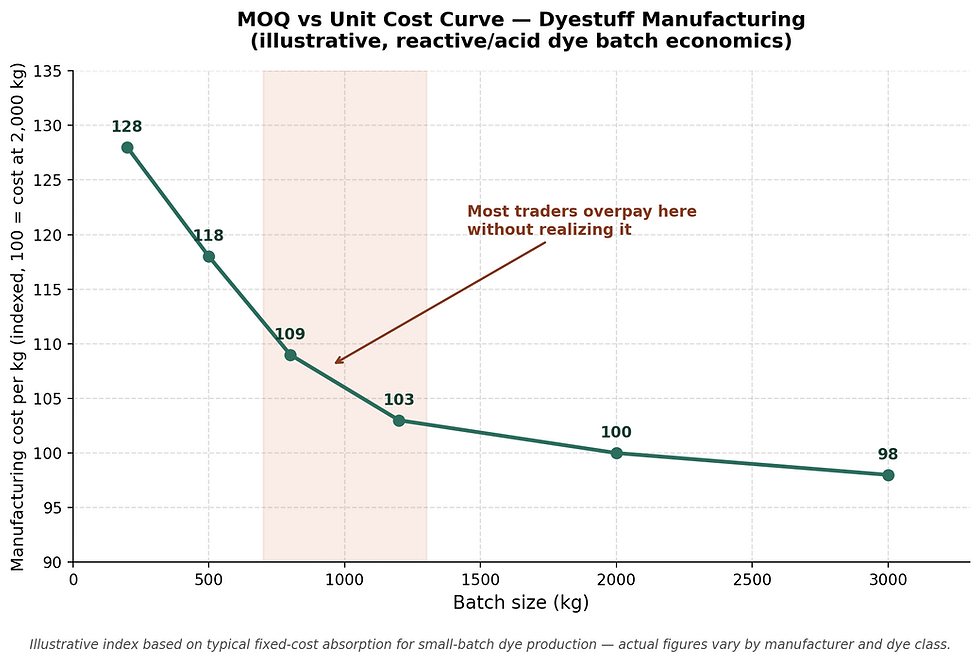
Traders who negotiate well don't fight the MOQ — they restructure the order to sit past the knee of the curve. Pooling orders across two of their own sub-distributors before placing the purchase order routinely moves a trader from the steep part of the cost curve to the flat part, where an extra 300–500 kgs barely moves the per-kg price at all.
Mixed-SKU consolidation: the container as a portfolio, not a single order
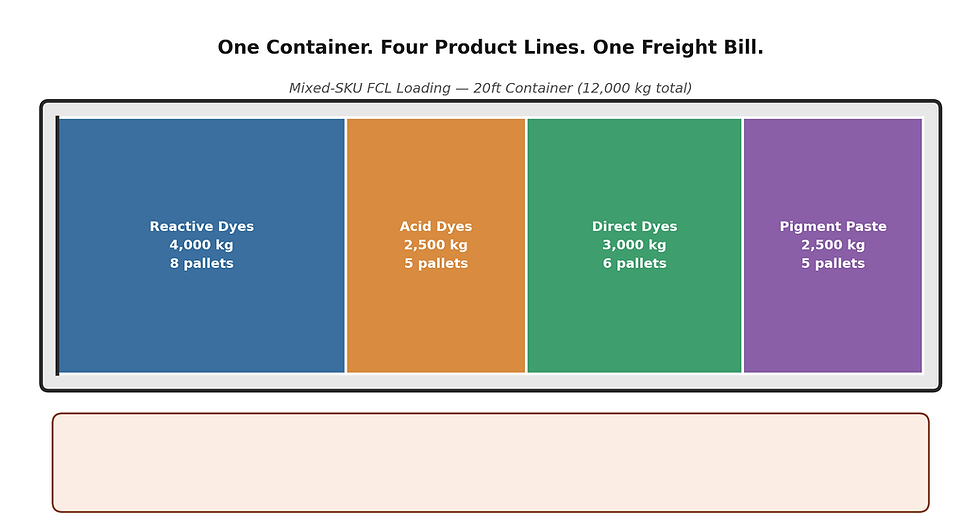
This is where the FCL/LCL problem and the MOQ problem solve each other. A trader rarely needs 12,000 kg of one dye class for one buyer. But a trader with active demand across Reactive, Acid, Direct, and Pigment lines can fill that same container with all four:
2,500 kg Acid for a leather tannery account
3,000 kg Direct for a paper mill customer
Each individual order clears its manufacturer's MOQ on its own. Freight is FCL instead of four separate LCL shipments. And using the worked numbers above, the trader's landed freight cost drops from roughly $0.65/kg (shipped separately, LCL) to under $0.10/kg (consolidated, FCL) — across every SKU in the container, not just one.
The catch is that this only works with a manufacturer set up to produce and pack multiple dye classes for one container booking, coordinate a single dispatch date across production lines, and paperwork it as one shipment with individual CoAs per batch. A supplier who only makes Reactive dyes can't help here even if their Reactive pricing is excellent, because the trader is still stuck sourcing Acid, Direct, and Pigment separately, on separate LCL bookings, undoing the entire saving. This is one of the more overlooked reasons experienced traders consolidate their sourcing toward one or two manufacturing partners rather than spreading purchase orders across the lowest bidder for each product line.
Payment terms and paperwork: where your own risk gets priced
None of the freight math matters if the shipment sits at the port because a CoA didn't match the contracted shade tolerance, or a buyer's customs broker rejects the paperwork over a missing MSDS. Traders absorb this risk twice — once on the inbound side with the manufacturer, and again on the outbound side with their own buyer, who is trusting the trader's word on quality just as much as the trader is trusting the manufacturer's.
Advance-against-CoA and LC-at-sight terms (standard under ICC Incoterms rules) are common for a reason: they let a trader release payment only once documentation confirms the batch matches spec, rather than trusting a sales promise. A trader quoting a buyer in Casablanca or São Paulo on 60-day terms is effectively extending credit that's only as safe as the manufacturer's documentation discipline upstream. Manufacturers who issue CoA, TDS, and MSDS as standard practice — not as something a trader has to request and wait a week for — let a trader quote tighter payment terms to their own buyers with less exposure, which is a real, quotable pricing advantage in a competitive bid.
What actually separates a partner from a supplier
A commodity supplier competes on this week's price and disappears the moment someone quotes a dollar less. A manufacturing partner worth building a multi-year relationship with tends to show up in smaller, less visible ways: consistent batch-to-batch shade matching so a trader doesn't have to re-explain tolerances every order, willingness to hold a mixed-SKU container booking open a few extra days so a fourth product line can be added, straight answers on MOQ math instead of a flat no, and documentation that arrives with the shipment rather than after three follow-up emails.
None of that shows up on a price list. It shows up in whether a trader's margin survives contact with the actual shipment, three months after the quote was given.
If you're building your sourcing around fewer, better manufacturing relationships rather than the lowest quote on any single order, that's usually a sign you're already doing this math. If you're not there yet, it's worth running the FCL/LCL and MOQ numbers on your last three shipments before placing the next one.
We work with traders and agents across Bangladesh, Vietnam, Turkey, Morocco, Indonesia, and beyond on exactly this kind of mixed-SKU, MOQ-friendly sourcing — Reactive, Acid, Direct, and Pigment from one factory, one container, one set of paperwork. If that's the kind of container math you're trying to solve for your next shipment, reach out and we'll run the numbers with you.
Frequently Asked Questions
Q. What is a typical MOQ for dyestuff manufacturers?
A. MOQs vary by dye class and manufacturer, but reactive and acid dyes commonly start in the 200–500 kg range per shade, with per-kg cost dropping meaningfully above 1,000–2,000 kg.
Q. Is FCL always cheaper than LCL for dye shipments?
A. Not automatically — it depends on total volume. But once a shipment clears roughly 8,000–10,000 kg (60–70% of a 20ft container), FCL per-kg freight is almost always lower than LCL, often by 4-6x as shown in the worked example above.
Q. Can I combine Reactive, Acid, Direct, and Pigment orders in one container?
A. Yes, if your manufacturer produces and packs all four lines and can coordinate a single dispatch date — this is one of the most effective ways traders lower landed cost per kg across an entire order, not just one product line.
Q. What documentation should I ask for on every dye shipment?
A. A Certificate of Analysis (CoA) matched to the batch, a Technical Data Sheet (TDS), and a Material Safety Data Sheet (MSDS) — ideally issued with the shipment, not after a follow-up request.
Q. How do payment terms affect a trader's margin?
A. Terms like advance-against-CoA or LC-at-sight reduce a trader's exposure to quality disputes, which in turn lets them quote tighter, more competitive terms to their own buyers.
Q. How do I know if I'm ordering below the optimal MOQ tier?
A. Compare your manufacturer's quoted price at your usual order size against their price at roughly double that volume. If the per-kg drop is more than 8-10%, you're likely still on the steep part of the cost curve and pooling demand across a quarter or across sub-distributors would help.


Great stuff
Very good and user friendly content..
Good info