
H Acid Price Shock 2026: Why It Jumped 136% Since February, and What It Means If You're Buying Dyes
If you're sourcing H Acid-linked dyes into Turkey, Bangladesh, Vietnam, Morocco, Brazil, Italy, Mexico or anywhere else outside India, you've probably already felt this in your supplier quotes even if nobody's explained why. In February 2026, domestic H Acid in India was trading around $5.85/kg (₹550). By September, it had climbed to roughly $13.80/kg (₹1,300) — a 136% increase in seven months, with more than half of that move happening in the last four weeks alone.

This isn't an India-only story. The cause is a China-driven feed-stock shock that's affecting H Acid supply and pricing globally. Here's what happened, what it means for your landed cost, and what to do before your next order.
📩 Want your current landed cost, in your currency, to your port? Email info@avichemicals.com with your destination and volume and we'll get you a live quote within one business day — not a number from last quarter.
The Price Timeline, in USD
Period | H Acid Price (Domestic India, approx.) | USD Equivalent* | Movement |
February 2026 | ₹550/kg | ~$5.85/kg (~$5,850/MT) | Baseline |
Mid-2026 | Gradual, steady climb | — | Feedstock and export pressure building |
~August 2026 | ₹850/kg | ~$9.05/kg (~$9,050/MT) | Sharp acceleration begins |
September 2026 | ₹1,300/kg | ~$13.80/kg (~$13,800/MT) | +53% in a single month |
*USD conversion at approximately ₹94/USD, September 2026. Exchange rates move — confirm the current rate when pricing a shipment. These are domestic India ex-works reference points; your actual landed cost will include freight, insurance, and duty specific to your port.
The Real Story: What China Did, and Why It's a Global Problem, Not Just India's
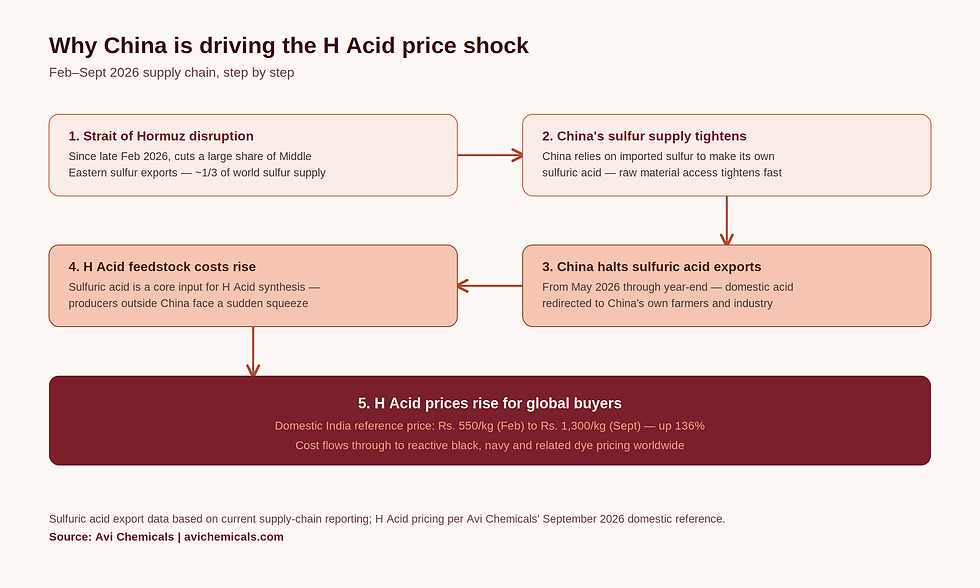
H Acid production depends heavily on sulphuric acid (oleum) as a core processing input during the sulphonation stage of manufacturing, alongside naphthalene as the base feed-stock. Both inputs have been hit by two compounding disruptions this year, and both trace back to China — which means this is hitting every H Acid-importing country, not just Indian buyers.
First, the Strait of Hormuz closure. Since late February 2026, disruption in the Strait of Hormuz has effectively cut off a large share of Middle Eastern sulphur shipments — a region that supplies roughly a third of global sulphur production and around half of all seaborne sulphur trade. China relies heavily on imported sulphur to feed its own sulphuric acid production, so this tightened raw material availability at the source.
Second, and more damaging, China moved from export quotas to a full halt on sulphuric acid exports starting May 2026, running through the end of the year. China's sulphuric acid exports had already fallen roughly 49% year-on-year in the first four months of 2026 under a quota system, before exports were cut off almost entirely from May onward, with domestic acid redirected to China's own agriculture and industry. Analysts covering the ban have described it as removing one of the last flexible supply valves in the global chemical supply chain, with markets expected to stay structurally short through the rest of 2026.
For a byproduct-dependent industry like H Acid manufacturing, that's a direct hit and it doesn't matter whether your dye supplier is in India, China, or anywhere else in Asia. Sulphuric acid that used to move freely between countries is now largely staying inside China, and what's left is being fought over by mining, fertiliser, and chemical processing industries with far larger buying power than the dyestuff intermediate trade.
On top of that, H Acid-specific supply out of China separately tightened Chinese export curbs and periodic plant outages had already been reducing prompt H Acid export availability through the first half of 2026, before the sulphuric acid ban fully took hold.
How This Hits You Depending on Where You're Buying From
If you're buying from China directly: You're closest to the source of the disruption. Expect the least price stability and the longest lead-time uncertainty, since Chinese producers are managing both an export sulphuric acid shortage and domestic prioritisation.
If you're buying from India (including through Avi Chemicals): Indian producers are also feeling the sulphuric acid squeeze, but with more diversified feed-stock relationships than pure China-dependent buyers, and typically more transparency on sourcing than trading-house resellers.
If you're buying finished reactive or acid dyes rather than H Acid itself (most traders in Turkey, Morocco, Brazil, and Southeast Asia): this cost is already baked into your supplier's quote whether they've explained it or not. The question isn't whether you're affected — it's whether your supplier is being straight with you about why the number moved.
Why the Last Month Moved So Much Faster Than the Rest of the Year
The February to August climb reflects the slow burn of these pressures building. The jump in the last month looks like something else: panic buying. When a major supplier of a critical input effectively exits the export market for the rest of the year, buyers who were previously purchasing on a rolling or spot basis rush to secure inventory before the shortage deepens further — pushing prices up faster than the underlying supply-demand gap alone would justify. That pattern has already been flagged by analysts covering the broader sulfuric acid disruption, and it lines up closely with what H Acid buyers are experiencing now.
🔒 Thinking about locking in Q4 volume before this moves further? We're currently able to offer allocation holds for confirmed Q4 orders. Message info@avichemicals.com with "Q4 HOLD" and your approximate volume.
What This Means for Your Dyestuff Costs
If you're sourcing reactive black, navy, or other H Acid-linked shades, this cost increase is moving directly into finished dye pricing, faster than usual because the shock itself has been fast. Any supplier still quoting you off Q1 or Q2 2026 costing is quoting you a number that no longer reflects their actual input cost — and if a supplier hasn't mentioned any of this to you, it's worth asking why.
This is also exactly the environment where the difference between a manufacturer with secured, contracted feedstock access and one buying inputs on the open spot market becomes visible in your quote. Ask directly how your supplier is sourcing sulphuric acid and H Acid right now.

Where This Is Headed
Nothing in the current picture points to a quick correction. China's sulphuric acid export restriction runs through the end of 2026, the Strait of Hormuz disruption has no confirmed resolution timeline, and analysts covering the broader chemical supply chain expect the global market to remain structurally short for the rest of the year. Plan for continued elevated pricing through Q4 2026 rather than betting on a reversal toward February levels.
The longer-term structural demand story for H Acid — driven by expanding textile production across India, Bangladesh, and Vietnam — hasn't gone anywhere either. Once the current feedstock shock eases, expect prices to settle at a new, higher baseline rather than fully retrace to where they started the year.
What Buyers and Traders Should Do Right Now
Get a live quote in your currency before you commit to anything. At this rate of movement, even a two-week-old number can be materially out of date.
Ask your supplier directly how they're sourcing sulphuric acid and H Acid. Contracted, secured feed stock access matters more right now than it has in years.
Don't panic buy into the spike. If you can stagger purchases or negotiate partial shipments, you reduce your exposure to buying at the absolute peak.
Diversify your supplier base now, not later. Relying on a single H Acid or dye source during a China driven supply shock leaves you with no fallback if your primary source tightens further.
Verify CoA, MSDS, and TDS on any new source you bring on under time pressure. Fast sourcing decisions are exactly when this paperwork gets skipped, and exactly when it matters most.
Why Traders Across 12+ Countries Work With Avi Chemicals During Shocks Like This
We've manufactured reactive, acid, and direct dyes out of our Ahmedabad facility since 1980, and we export on a manufacturer-to-trader and agent model to partners across Bangladesh, Vietnam, Turkey, Morocco, Indonesia, Italy, Spain, Brazil, Russia, and the Philippines. Two things matter most to buyers reaching out to us during this specific shock: we manufacture directly rather than reselling, so we can tell you plainly where our costs actually stand, and every batch ships with our own in-house Certificate of Analysis, MSDS, and TDS — no chasing a trading house for paperwork after the fact.
In a market moving this fast, we'd rather give you a straight, current answer than let you plan around a number that's already stale.
Get a current quote or lock in Q4 allocation: info@avichemicals.com | avichemicals.com Prefer WhatsApp? Message us directly for a same-day response.
📥 Get the Q4 2026 H Acid Supply & Price Outlook
Want a heads-up before the next move, not after? We're tracking this shock weekly. Leave your email and destination country and we'll send you a short update whenever the picture changes materially — no spam, no sales pitch, just the number and why it moved.
FAQ SECTION
Q. Why has the H Acid price increased so much in 2026?
A. H Acid prices rose from around $5.85/kg (₹550) in February 2026 to roughly $13.80/kg (₹1,300) by September — a 136% increase — driven primarily by a China-linked feedstock shock: a sulfuric acid export halt starting May 2026, compounded by a Strait of Hormuz disruption affecting global sulfur supply since late February.
Q. Does this affect buyers outside India, or just the Indian domestic market?
A. It affects global buyers. The root cause — China's sulphuric acid export halt and the Hormuz-driven sulphur shortage — impacts H Acid producers in China, India, and anywhere else that depends on internationally traded sulphuric acid, so the cost pressure is showing up in supplier quotes worldwide, not just in India.
Q. Why did the price jump so fast in the last month specifically?
A. The sharpest move, from roughly $9.05/kg to $13.80/kg, reflects panic buying as China's sulphuric acid export halt took full effect and buyers rushed to secure inventory before supply tightened further.
Q. What does China's sulphuric acid export ban have to do with H Acid?
A. Sulfuric acid is a core processing input in H Acid manufacturing. China halted sulfuric acid exports from May 2026 through the end of the year, redirecting domestic supply to its own agriculture and industry, which sharply reduced availability and raised costs for H Acid producers outside China who rely on that acid.
Q. Is this a temporary spike or a longer-term shift?
A. Current signals point to continued elevated pricing through at least Q4 2026, since China's export restriction runs through year-end and the Strait of Hormuz disruption has no confirmed resolution timeline. A full reversal to February 2026 price levels looks unlikely in the near term.
Q. I buy finished reactive or acid dyes, not raw H Acid. Does this still affect me?
A. Yes. H Acid is a key input for reactive black, navy, and related shades, so this cost increase flows directly into finished dye quotes — particularly from suppliers buying H Acid on the spot market rather than through secured, contracted supply.
Q. Are you still able to ship on schedule despite the shortage?
A. Yes — Avi Chemicals maintains direct manufacturing and existing supply relationships, so current orders are shipping on normal lead times. If that changes for a specific order, we'll tell you upfront rather than let a shipment date slip silently.
Q. What are your payment terms and minimum order quantity for international buyers?
A. Terms vary by destination and order size — get in touch at info@avichemicals.com with your target volume and country and we'll confirm current terms, MOQ, and Incoterms options (FOB, CIF, CFR) for your shipment.
Q. How can I protect my business from further H Acid price volatility?
A. Diversify to a second qualified, vetted supplier, ask direct questions about how your current supplier sources sulfuric acid and H Acid, and verify CoA, MSDS, and TDS documentation before onboarding any new source under time pressure.

Nice details. Market very unstable. Not able to work at these prices.
Thanks for sharing this information in detail...
Informative. Thanks for sharing.